2019年9月25日水曜日

【Environmental Protection Project】 Quarterly Report ~April to June 2019~

Please see the Quarterly Report(April-June 2019) on
'Environmental Protection through Expanding Lemon Grass Growing and Education in Uganda'


You can find the details in the reports below,
 ↓


Thank you!!!


*This project is supported by Japan Fund for Global Environment of the Environmental Restoration (JFGE) and by Environmental Restoration and Conservation Agency (ERCA)


2019年9月6日金曜日

Introduction of Secretary-general, Miho Yokota


I was interested in international cooperation in the lower grades of elementary school. I was shocked as the same child when I saw on TV that African children died of hunger and illness. I, as a child, wanted to help children who were suffering, and I began donating money to UNICEF every year. To work at UNICEF in the future, I thought, at that time, that I needed to study international relations and international politics. I entered a University and majored in Law and Politics. I met Dr. Akira Kurihara, who studies issues of Minamata and Okinawa and who teaches political sociology. I learned from him that the importance of assisting socially vulnerable people and confronting the absurd world. Confronting the absurdity of society became “a mission of my life.” Then, I got a master's degree in international policy studies at a graduate school in the United States, and I met Ms. Maiko Ohnishi, the representative of GBN at that school.

Graduation Ceremony 2008

After graduating from graduate school, I started working for a Japanese NGO supporting Africa, Mozambique, and I was assigned to work in Mozambique as the director of the Mozambique office in 2009. I conducted peacebuilding activities, educational support, vocational training, development of fair trade products, and community development with a local NGO. Since 2012, I worked in northern Mozambique for a Japanese company, and I involved in agricultural, biofuel and rural finance projects with the aim of local production and local consumption of food, energy and finance to support local populations.

The agricultural project in northern Mozambique.
We exhibited rice purchased from local farmers.

During my nine years in Africa, I struggled with troubles and difficulties. I faced difficulties such as struggling with Portuguese communication with local staffs, power outage for a month, water outrage for a long time and transporting water every day, malaria, dengue fever etc. Also there were a lot of painful incidents such as I lost some of my important colleagues.

Even so, I was able to overcome the difficulties and be saved by the vitality and cheerful personality of African people, the spirit of helping each other, and the ability to confront difficulties. When I am in Africa, I feel the senses of human beings that I have forgotten in developing countries, such as humanity, a sense of being alive, and survival instincts are restored. I am fascinated by Africa, which reminds me of such an important physical and intellectual abilities.

Children in Bondoia village, southern Mozambique.

I would like to contribute to the projects of GBN in African countries as the secretary-general based on my experience in Mozambique. I would like to help people to improve their lives by assisting their independence. And I want to spread the attractive points of Africa through various activities. Thank you very much for your continued support to GBN!

Miho Yokota


2019年8月6日火曜日

【Environmental Protection】Making new products (soap and candles)

Hello, this is Global Bridge Network (GBN)!
Regarding ‘Environmental Protection through Expanding Lemon grass growing and Education in Uganda’, this is the last report of 2nd year of this project.

Display of the steps to follow when making liquid soap


This time, ‘Activity 3.9 Make new products (soap and candles)’ was conducted on Feb 2019. 

Activities:
This report presents an explanation of what SORAK went through in its attempt to make products that would use lemon grass essential oil as a raw material. The activity took the form of training for SORAK staffs basically on creating two items, namely candle and liquid soap


Material for candle making on display


Outcomes:
Ø  SORAK staffs equipped with skills in making of candles and liquid soap and got prepared to commence with these products making in the third year of JFGE funding.
Ø  After the trainings, SORAK staff also trained out of school youths in the making of candles and soap. This took place in Lusalira where SORAK office is located.
Ø  Participants appreciated the usefulness of lemon grass and how it can be used to blend important and useful products.
Ø  The activity prepared SORAK to plan for future revenue generating activities that can keep the organization moving even without future donor support.


You can find the details in the reports below,

Product making and sales using lemon grass essential oil 
will start at the next 3rd project

*This project is supported by Japan Fund for Global Environment of the Environmental Restoration (JFGE) and by Environmental Restoration and Conservation Agency (ERCA)

2019年7月28日日曜日

【Environmental Protection】Expanding lemon grass production and Carryout harvesting and delivery of lemon grass to the distiller

Hello, this is Global Bridge Network (GBN)!
Regarding ‘Environmental Protection through Expanding Lemon grass growing and Education in Uganda’, this is the eighth report of 2nd year of this project.


Off loading newly delivery lemon grass

This time, ‘Activity 3.8: Expanding lemon grass production and carryout harvesting and delivery of 20 tons of lemon grass to the distiller’ was conducted from June 2018 to March 2019. This is a continuous activity that repeatedly required every 60 days during rainy season.

Purpose:
The purpose of this activity is to ensure continuous supply of raw lemon grass for eventual distillation of essential lemon grass oil. It also aims at providing a source of livelihood to lemon grass farmers. This is because the farmers are able to earn some income that is provided by SORAK every time raw lemon grass is harvested from the farmers. It also indirectly contributes to environmental protection. This is because lemon grass provides a grass cover to the soil hence preventing soil erosion which is common on hilly plateau landscapes of the project area.

Activities:
1.     Arrangement of collecting schedule and informing farmers to harvest.

2.     Hiring a collection truck and a driver.
3.     Mobilization of farmers/make appointments and agree of harvesting date and time.
4.     Travelling to villages to collect lemon grass
5.     Loading and delivering lemon grass to SORAK lemon distiller shade.
6.     Spreading the lemon grass while in shade to wither for 4-7 days before distilling.       


Filling gunny bags to spread the grass for withering

A bulk of delivered lemon grass

Distillation in process, bending after supervising 
the emptying of the distiller pan
Outcomes:
1.   Provided an opportunity to farmers to generate income.
2. Motivated farmers to grow lemon grass for income generation and also to help in protecting the soil from agents of soil erosion. More farmers started growing lemon grass as a soil erosion control grass but on a small scale.
3. Production of essential oil from distillation for selling and creating soaps or candles.  SORAK was able to produce 8 liters of oil every time and we harvested 12 tons of raw material every 60 days.


You can find the details in the reports below,

*This project is supported by Japan Fund for Global Environment of the Environmental Restoration (JFGE) and by Environmental Restoration and Conservation Agency (ERCA)


http://globalbridgenetwork.org/en/


2019年7月22日月曜日

【Environmental Protection】Briquette charcoal production and collection of solid waste

Hello, this is Global Bridge Network (GBN)!
Regarding ‘Environmental Protection through Expanding Lemon grass growing and Education in Uganda’, this is the sixth report of 2nd year of this project.

Briquette charcoal 
This time, new activities: ‘Activity 3.6: Establish a briquette charcoal production unit’ and ‘Activity 3.7 Conduct collection of solid waste for briquette production’ were conducted from January 2019.

♪Effective utilization of  wastage of lemon grass♪

Outline:
It is able to undertake to produce briquette charcoal after learning of the wastage of lemon grass after extraction of oil. Making briquette would also help in achieving sustainable crop waste management. The activity was also intended to make use of lemon grass after extraction of oil as well as other crop waste like maize stalk and other organic domestic waste. This would enable us to achieve sustainable cooking energy which is also essential in saving that trees that are cut in search of wood charcoal and firewood.

Activities:
Activity 3.6 Establishing briquette charcoal production unit.
1. Conducting a feasibility study to investigate if raw materials for making good briquette were available
2.  Transportation of briquette production machines from Capital city Kampala and its installation.
3. Collection of materials and constructing the briquette charcoal making shade and the briquette charcoal drying rake
4.  Installing parts of the production unit and conducting production tests.
5.  Training staff on the marketing and promotion of briquette charcoal

Activity 3.7 Collecting solid, farm and domestic waste from communities
1.     Mobilization of 20 farmers to accept solid waste provision to our collectors.
2.     Collectors moving to the villages to collect 60 tons of solid waste.
3.     Collectors collecting and dumping waste at our briquette charcoal making factory

Loading Briquette production machine
Preparing the ground for drier construction
Drier construction in Progress

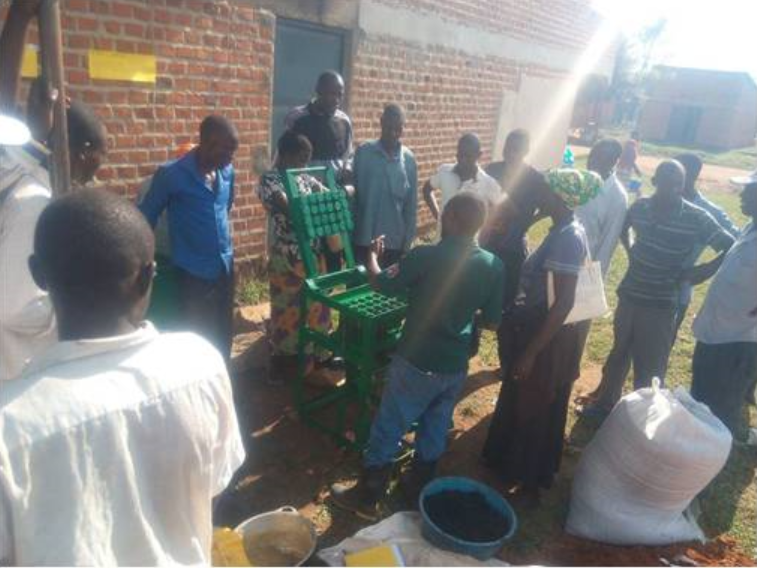
Facilitating the training on marketing of Briquettes

Waste, Maize corns collected 

Organic waste used to produce char


Char being removed from mixer


 trainee studying the Briquette charcoal producing machine 

 Outcomes:
Ø  Obtained a briquette production and related business training manual
Ø  Created opportunities for youths who are involved in the routine production and sales of briquette to the community and other consumers.
Ø  Introduced monetarization of crop waste that farmers have been just wasting/burning
Ø  More trees will be saved in the future as households would turn to use briquette for cooking instead of using fire wood/ wood charcoal.
Ø  Enough solid waste material for briquette charcoal production was collected and stored for continuous production of briquette charcoal


You can find the details in the reports below,
*This project is supported by Japan Fund for Global Environment of the Environmental Restoration (JFGE) and by Environmental Restoration and Conservation Agency (ERCA)