2019年7月28日日曜日

【Environmental Protection】Expanding lemon grass production and Carryout harvesting and delivery of lemon grass to the distiller

Hello, this is Global Bridge Network (GBN)!
Regarding ‘Environmental Protection through Expanding Lemon grass growing and Education in Uganda’, this is the eighth report of 2nd year of this project.


Off loading newly delivery lemon grass

This time, ‘Activity 3.8: Expanding lemon grass production and carryout harvesting and delivery of 20 tons of lemon grass to the distiller’ was conducted from June 2018 to March 2019. This is a continuous activity that repeatedly required every 60 days during rainy season.

Purpose:
The purpose of this activity is to ensure continuous supply of raw lemon grass for eventual distillation of essential lemon grass oil. It also aims at providing a source of livelihood to lemon grass farmers. This is because the farmers are able to earn some income that is provided by SORAK every time raw lemon grass is harvested from the farmers. It also indirectly contributes to environmental protection. This is because lemon grass provides a grass cover to the soil hence preventing soil erosion which is common on hilly plateau landscapes of the project area.

Activities:
1.     Arrangement of collecting schedule and informing farmers to harvest.

2.     Hiring a collection truck and a driver.
3.     Mobilization of farmers/make appointments and agree of harvesting date and time.
4.     Travelling to villages to collect lemon grass
5.     Loading and delivering lemon grass to SORAK lemon distiller shade.
6.     Spreading the lemon grass while in shade to wither for 4-7 days before distilling.       


Filling gunny bags to spread the grass for withering

A bulk of delivered lemon grass

Distillation in process, bending after supervising 
the emptying of the distiller pan
Outcomes:
1.   Provided an opportunity to farmers to generate income.
2. Motivated farmers to grow lemon grass for income generation and also to help in protecting the soil from agents of soil erosion. More farmers started growing lemon grass as a soil erosion control grass but on a small scale.
3. Production of essential oil from distillation for selling and creating soaps or candles.  SORAK was able to produce 8 liters of oil every time and we harvested 12 tons of raw material every 60 days.


You can find the details in the reports below,

*This project is supported by Japan Fund for Global Environment of the Environmental Restoration (JFGE) and by Environmental Restoration and Conservation Agency (ERCA)


http://globalbridgenetwork.org/en/


2019年7月22日月曜日

【Environmental Protection】Briquette charcoal production and collection of solid waste

Hello, this is Global Bridge Network (GBN)!
Regarding ‘Environmental Protection through Expanding Lemon grass growing and Education in Uganda’, this is the sixth report of 2nd year of this project.

Briquette charcoal 
This time, new activities: ‘Activity 3.6: Establish a briquette charcoal production unit’ and ‘Activity 3.7 Conduct collection of solid waste for briquette production’ were conducted from January 2019.

♪Effective utilization of  wastage of lemon grass♪

Outline:
It is able to undertake to produce briquette charcoal after learning of the wastage of lemon grass after extraction of oil. Making briquette would also help in achieving sustainable crop waste management. The activity was also intended to make use of lemon grass after extraction of oil as well as other crop waste like maize stalk and other organic domestic waste. This would enable us to achieve sustainable cooking energy which is also essential in saving that trees that are cut in search of wood charcoal and firewood.

Activities:
Activity 3.6 Establishing briquette charcoal production unit.
1. Conducting a feasibility study to investigate if raw materials for making good briquette were available
2.  Transportation of briquette production machines from Capital city Kampala and its installation.
3. Collection of materials and constructing the briquette charcoal making shade and the briquette charcoal drying rake
4.  Installing parts of the production unit and conducting production tests.
5.  Training staff on the marketing and promotion of briquette charcoal

Activity 3.7 Collecting solid, farm and domestic waste from communities
1.     Mobilization of 20 farmers to accept solid waste provision to our collectors.
2.     Collectors moving to the villages to collect 60 tons of solid waste.
3.     Collectors collecting and dumping waste at our briquette charcoal making factory

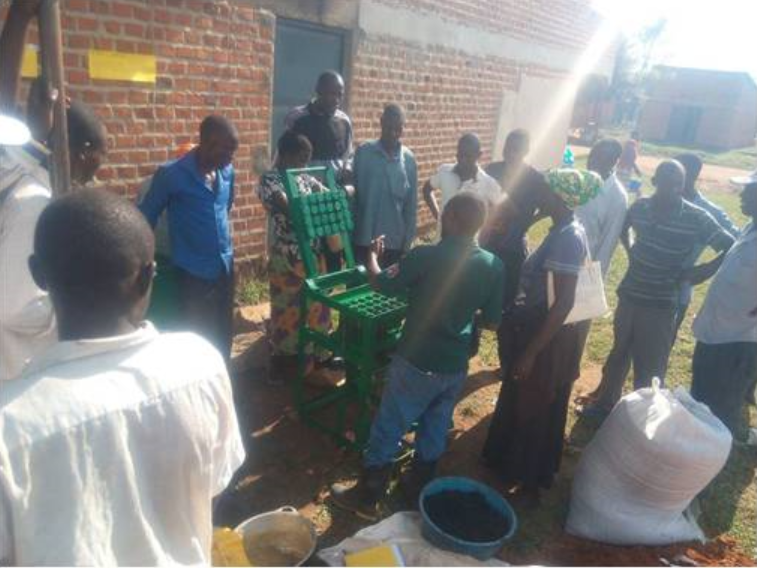
Loading Briquette production machine
Preparing the ground for drier construction
Drier construction in Progress

Facilitating the training on marketing of Briquettes

Waste, Maize corns collected 

Organic waste used to produce char


Char being removed from mixer


 trainee studying the Briquette charcoal producing machine 

 Outcomes:
Ø  Obtained a briquette production and related business training manual
Ø  Created opportunities for youths who are involved in the routine production and sales of briquette to the community and other consumers.
Ø  Introduced monetarization of crop waste that farmers have been just wasting/burning
Ø  More trees will be saved in the future as households would turn to use briquette for cooking instead of using fire wood/ wood charcoal.
Ø  Enough solid waste material for briquette charcoal production was collected and stored for continuous production of briquette charcoal


You can find the details in the reports below,
*This project is supported by Japan Fund for Global Environment of the Environmental Restoration (JFGE) and by Environmental Restoration and Conservation Agency (ERCA)

2019年7月7日日曜日

【Environmental Protection】Quarterly review meetings to assess progress and challenges of environmental protection regulations

Hello, this is Global Bridge Network(GBN)! 
Regarding ‘Environmental Protection through Expanding Lemon grass growing and Education in Uganda’, this is the fifth report of 2nd year of this project.

The Village leader emphasizing the importance of environmental protection.

This time, ‘Activity2.
5 Conduct quarterly review meetings to assess progress and challenges of environmental protection regulations adherence and implementation’ were started from June 2018. This quarterly meeting is conducted total 4times.

Activities:
The quarterly review meetings were intended to assess the following issues;
- Project progress in terms of achievements
- Identification of challenges 
- Devising methods and strategies of overcoming challenges
- Ensuring that all communities, sub counties and district stakeholders are adequately involved in and updated on this project.
- Promoting project ownership by the communities and local government which would promote sustainability even after this project.


The Assistant chief administrative officer, 
talking about the need to protect environment

A Police officer explaining the community members 
about the laws governing environment

SORAK Director presenting achievements at review meeting

   
Outcomes:
Ø  Local leaders agreed to enforce laws and regulations concerning environmental protection.
Ø  School representatives agreed to take on tree planting as a serious and important activity including planting fruit trees as these trees would make their schools environmentally friendly.
Ø  The police gave a stern warning to all leaders and community members to go and inform the general public about the impending surveillance that would include arresting all people who were found encroaching on the environment.
Ø  Leaders asked SORAK to continue providing support in form of review meetings, providing materials for tree planting and lemon grass planting, as these would lead to environmental protection and conservation.
Ø  The Police together with district officers promised to print out copies of environment protection regulations and display them in the community centre. 


You can find the details in the reports below,

*This project is supported by Japan Fund for Global Environment of the Environmental Restoration (JFGE) and by Environmental Restoration and Conservation Agency (ERCA)

2019年6月30日日曜日

☆The 3rd anniversary of GBN’s foundation!☆


Hello everyone!
Greeting from Global Bridge Network(GBN).


I am pleased to announce that GBN is now in its third year.

Please review the 2018 annual report.
As international support, our ongoing project on “Improvement of Educational Environment for Girls” in Uganda is fully underway and a new product, the reusable sanitary pad“Happy Pad”, is now available to expand the number of girls who can go to school during menstruation.

Reusable Sanitary Pad ’Happy Pad’

Everyone is Happy with ’Happy Pad’’


In addition, the “Environmental Protectionand Education” program involves environmental protection efforts through lemon grass growing and essential oil production, and is also proceeding. In addition, we have started the production of briquette charcoal, which is an environmentally friendly product made of organic waste and which can avoid emitting smoke in the atmosphere. 

Briquette Charcoal


Please take a look at the following video clips created during my field visi last year.
I am also pleased to announce that Hadijah, a program manager from our partner NGO SORAK, arrived in Japan from Uganda to attend the Rural Leaders Training Program (9 months) at the Asia RuralInstitute in Nasu Shiobara, Japan. 

Hadijah at the Asia Rural Institute
GBN supported her application to the best of our ability, and she is now (June 2019) actively learning new methods of agriculture and eager to expand organic methods in Uganda after this program. GBN is also willing to continue supporting her and her future plan to apply what she learnt in Japan to the agricultural field in Uganda.


I also appreciate ECS Co., for which I am currently working, for introducing GBN on their website as a CSR activity → CSR page


As we mark our third fiscal year, we welcome any new members and are pleased if you are interested as a volunteer in joining us.


Thank you very much for your support and cooperation.

Global Bridge Network
Maiko Ohnishi


2019年6月17日月曜日

【Environmental Protection】Support quarterly surveillance on laws and regulations of environmental protection


Hello, this is Global Bridge Network (GBN)!
Regarding ‘Environmental Protection through Expanding Lemon grass growing and Education in Uganda’, this is the fourth report of 2nd year of this project.

The district environment officer monitoring with file a damage of the wetland

This time, ‘2.4 Activity Support quarterly surveillance by environmental officers on laws and regulations of environmental protection formulated in year 1’ were started from June 2018. This quarterly surveillance is conducted total 4 times.

 
Activities:
    Conducting on site visits to wetlands and checking any human activity therein.
    Taking measurements with the community to show them wetland boundaries. This would enable them now the limit of their farming or any other activities.
    Informing the wetland users and neighbors of the acceptable and non-acceptable activities in wetlands.
    Investigating other activities include tree planting in upland communities in Bagezza seed secondary school.
  
Fauna-Uganda crested crane, birds are threatened by the maize crop

team and community measuring the extent of wetland encroachment 

SORAK ED waters a tree after planting in remembrance of the surveillance


Outcomes:
Ø  Police together with district officers promised to print out copies of regulations for environment protection and display in Community Centers.
Ø  Police promised to monitor any violation of laws of environment protection and assured that culprits will be brought to face charges/ punishments.
Ø  Some sites visited welcomed the idea and responded by planting trees as a sign of supporting the idea of surveillance and continued protection of our environment. For example, at Bagezza seed secondary where 5 trees were planted.


You can find the details in the reports below,


*This project is supported by Japan Fund for Global Environment of the Environmental Restoration (JFGE) and by Environmental Restoration and Conservation Agency (ERCA)


2019年6月11日火曜日

【Environmental Protection】Train children environmental protection activists in monitoring and reporting of environmental abuse


Hello, this is Global Bridge Network (GBN)!
Regarding ‘Environmental Protection through Expanding Lemon grass growing and Education in Uganda’, this is the fourth report of 2nd year of this project.

This time, ‘Activity 1.8 Train 160 children environmental protection activists in monitoring and reporting of environmental abuse’ were carried out on Sep 2018.

Children demonstrating the effects of environmental degradation
through a short drama

The environmental protection activist’s trainings were attended by 40 children selected from different schools and total participants are 160 children. 

The activity was provided children with the existing laws and regulations concerning environmental protection as well as the trained children would later become activists who could monitor and report environmental abuse deteriorated due to human activities. They would later grow in responsible for making environment alert and becoming environmentally friendly citizens.

Activities:
  • Trained the children as environmental protection activists in monitoring and reporting environmental abuse such as the careless and irresponsible activities of human beings like bush burning, bad waste disposal, deforestation, and wetland misuse.
  • Trained the children to follow up the progress of environmental activities by the environmental protection clubs formed in other 16 schools.
  • Trained the children on school and community based environmental conservation to take lead on tree and lemon grass planting in the future.
  • Informed the children their role towards environmental conservation including raising awareness about environmental protection in public and schools to cover issues related to water, air, waste reduction and recycling, as well as biodiversity.


Children trained into environmental protection

Children trained into environmental protection②

Children trained into environmental protection③

Outcomes:
Ø  Environmental walks by environmental protection activists were carried out by Mungungulu P/S activists and this has led to reduced cutting down of trees in Baggezza sub-county.
Ø  Reported cases of environmental abuse at sub counties by children environmental protection activists  have led to reduce encroachment on wetlands in Kigando Sub county
Ø  Children started participating in routine environmental clean ups with local leaders.


You can find the details in the reports below,
*This project is supported by Japan Fund for Global Environment of the Environmental Restoration (JFGE) and by Environmental Restoration and Conservation Agency (ERCA)